Few terms in astrology cause as much worry as Sade Sati. People hear it and brace for seven and a half years of hardship.
The fear is mostly misunderstanding. Sade Sati is a Saturn transit, not a curse. It is a long planetary period that asks for growth, patience, and responsibility.
The honest frame is this: Sade Sati brings life lessons, not punishment. Met with awareness, it is a phase to work with, not something to dread.
This guide explains Sade Sati in simple terms, including how it works, the role of Saturn, its three phases, and the common myths around it.
Sade Sati is among the most talked-about periods in Vedic astrology, yet also one of the most misunderstood. Before believing the fears, it helps to understand what Sade Sati actually means.
Sade Sati is the approximately seven-and-a-half-year period during which Saturn transits the zodiac sign before your Moon sign, your Moon sign itself, and the sign after it. In Vedic astrology, this transit represents a phase of responsibility, maturity, and long-term personal growth rather than guaranteed hardship.
Sade Sati is calculated from your Moon sign, not your Sun sign. The period begins when Saturn enters the zodiac sign immediately before your Moon sign, continues while Saturn transits your Moon sign, and ends after it leaves the following sign. Since Saturn spends around two and a half years in each zodiac sign, the complete transit lasts approximately seven and a half years. While Sade Sati is measured from the Moon sign, understanding your zodiac sign can provide additional insight into your overall astrological personality.
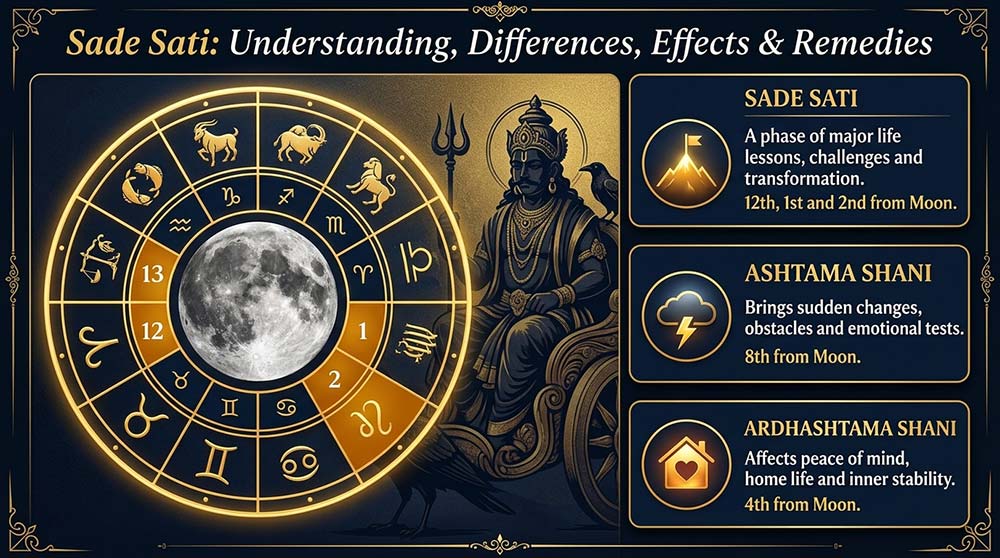
In Vedic astrology, Sade Sati is measured from your Moon sign, not your Sun sign. The Moon represents your mind, emotions, habits, and inner world, making it the most important reference point for this Saturn transit. As Saturn moves through the three signs surrounding your Moon, it influences how you respond to responsibilities, challenges, and personal growth. Rather than predicting misfortune, Sade Sati highlights periods that encourage maturity, resilience, and a more disciplined approach to life.
Understanding the meaning and basis of Sade Sati replaces uncertainty with clarity. The next step is to explore how each of its three phases shapes different areas of life. The calculations behind these planetary movements are rooted in the traditional Hindu calendar, which forms the basis of Vedic astrology.
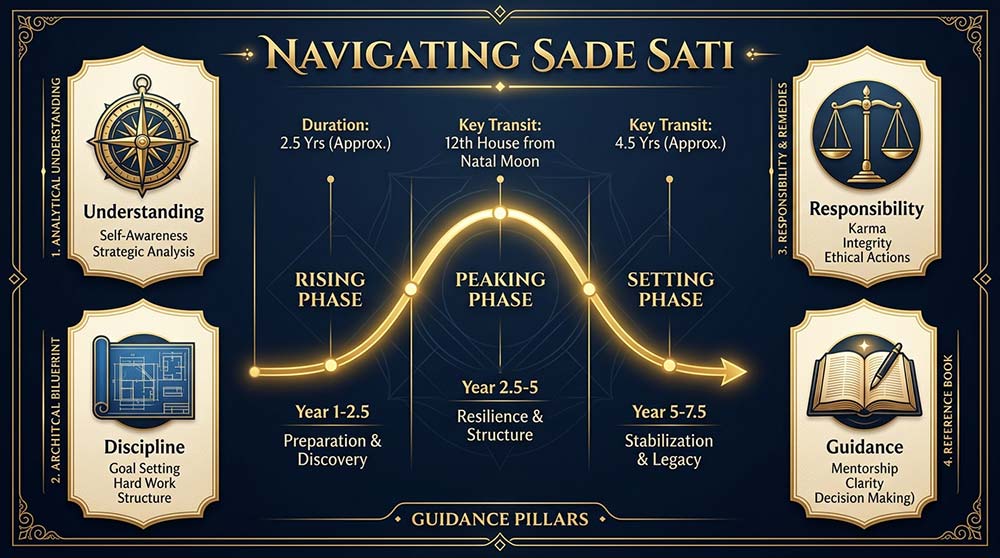
Sade Sati progresses through three consecutive phases, each reflecting a different stage of Saturn’s transit around your Moon sign. Understanding these phases provides valuable context, helping you interpret changing responsibilities, emotional experiences, and opportunities for personal growth with greater clarity.
Sade Sati unfolds in three distinct phases as Saturn moves across the zodiac signs surrounding your Moon sign. Each stage brings a different emphasis, shaping your experiences and personal development over time.
Each phase of Sade Sati brings a different focus and purpose. Rather than affecting everyone in the same way, the transit gradually shifts your priorities, encouraging growth, responsibility, and a more balanced approach to life’s changing circumstances.
The table below summarises the three phases of Sade Sati, their duration, and the broad areas of life they commonly emphasise.
| Phase | Duration | Primary Focus |
|---|---|---|
| 1st Phase (Rising) | 2.5 Years | New responsibilities, changing priorities, and building stronger foundations. |
| 2nd Phase (Peak) | 2.5 Years | Emotional resilience, discipline, self-reflection, and personal maturity. |
| 3rd Phase (Setting) | 2.5 Years | Integration of lessons, greater stability, and renewed confidence for the future. |
Every individual’s experience differs based on the complete birth chart, planetary positions, and the current phase of Sade Sati.
Each phase has a job. Knowing which one you are in changes how you meet it. A Timing & Clarity consultation can place you in your phase.
Much of Sade Sati’s reputation comes from misconceptions rather than astrology itself. Understanding the facts behind this Saturn transit helps separate genuine astrological guidance from fear, allowing you to approach the period with greater confidence, perspective, and informed decision-making.
The biggest myth is that Sade Sati guarantees disaster. It does not. Among the common sade sati myths and facts: it is not the same for everyone, it does not ruin every area of life, and it is not lifted by panic. Another myth is that everyone suffers equally. In truth, your moon sign, your full chart, and the phase you are in all change how the period feels. For many, the period brings discipline that supports personal growth and helps them handle important life phases with more maturity.
A person entered Sade Sati fearing the worst. Instead of sudden misfortune, the period brought greater responsibilities at work, better financial discipline, and healthier habits. The challenges were real, but they ultimately led to greater confidence, stability, and personal growth.
Broader Astrology Predictions can also help you understand how other planetary transits may influence different areas of life alongside Sade Sati.
You cannot avoid the transit. You can meet it well. A few steady habits make the difference.
Met with awareness, Sade Sati becomes a teacher rather than a threat. The pressure has a purpose. Not sure whether your Sade Sati has started or which phase you’re currently experiencing? Use our Sade Sati Calculator to check your current Saturn transit instantly.
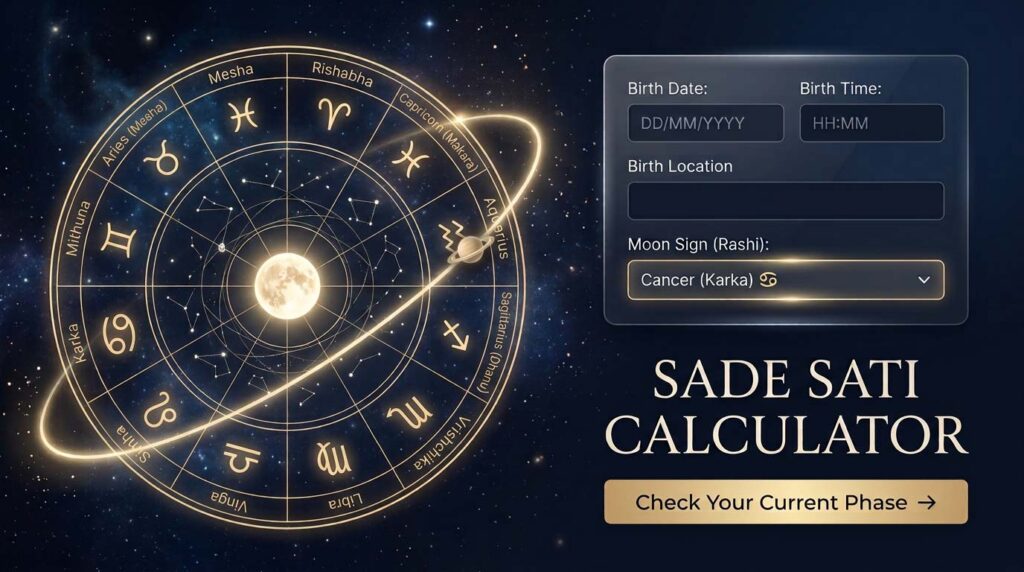
Sade Sati lasts approximately seven and a half years, beginning when Saturn enters the zodiac sign before your Moon sign and ending after it leaves the sign immediately following your Moon sign.
No. Sade Sati is not considered inherently negative. While it may bring greater responsibilities and important life lessons, it also offers opportunities for discipline, personal growth, resilience, and long-term positive transformation.
Sade Sati earns its reputation only when it is misunderstood. Seen clearly, it is a long Saturn transit that asks for growth, not a guarantee of suffering.
Know your phase, hold to discipline, and meet the period with awareness rather than fear. That is how Sade Sati becomes a season of maturity instead of dread.
To understand where you are in your own Sade Sati, a personal Vedic astrology consultation can map your phase and timing. Book a session and face the period with clarity.


Leave a Reply